
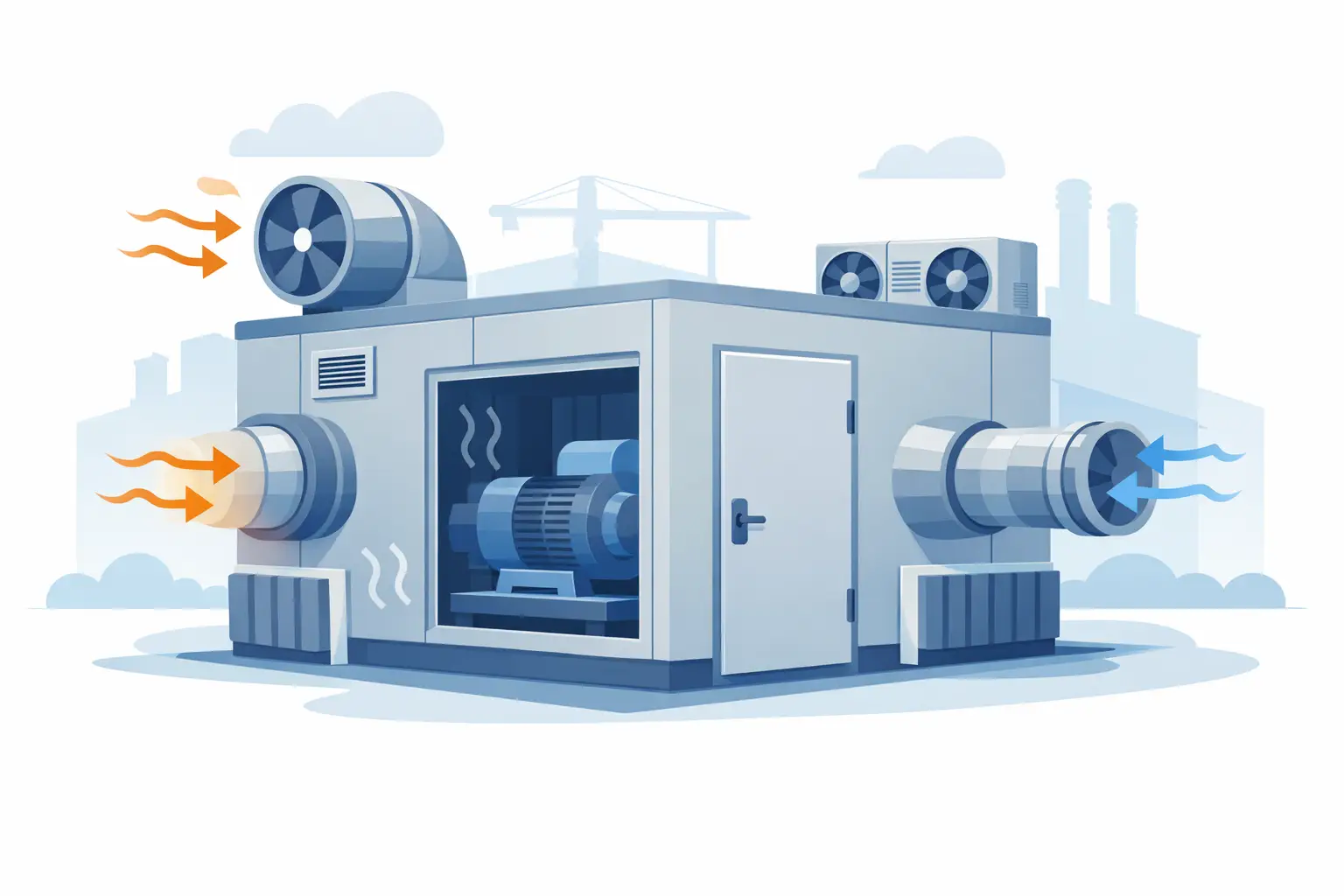
A generator enclosure that meets the noise target but overheats after an hour is not a successful design. Neither is an enclosure with strong airflow that leaks breakout noise through every intake and discharge path. Acoustic enclosure ventilation design has to solve both problems at the same time, under real operating conditions, with no room for guesswork.
For industrial equipment, ventilation is not an accessory to acoustic treatment. It is part of the acoustic system. Engines, compressors, blowers, hydraulic power units, and process machinery all convert energy into heat as well as noise. Once that equipment is enclosed, the designer has to manage temperature rise, pressure drop, service access, weather protection, and insertion loss as one coordinated package. If any one of those elements is treated in isolation, the enclosure will underperform in the field.
Why acoustic enclosure ventilation design fails
The most common failure starts with a simplified assumption: add enough opening area for air, then line the enclosure for sound. On paper, that can appear adequate. In operation, it often produces high air velocity, uneven cooling, tonal breakout, and unacceptable static pressure.
Air follows the path of least resistance. Sound does the same. Every ventilation opening is a potential leakage path, especially at mid and high frequencies. At the same time, every bend, splitter, louver, and sound trap added for noise control increases resistance to airflow. That is the basic conflict in acoustic enclosure ventilation design. Good engineering does not remove the trade-off. It manages it deliberately.
Heat rejection data is also frequently underestimated. Equipment vendors may provide rated airflow, radiator duty, or combustion air requirements under ideal conditions, but enclosure conditions are different. Ambient temperature, recirculation risk, elevation, duct routing, and fouling all change actual performance. A design that works in a mild climate with short duty cycles may fail in a hot plant environment running continuously.
Start with the heat load, not the panel lining
The correct sequence begins with thermal demand. Before selecting acoustic louvers or silencer sections, the design team should establish how much heat must be removed, what maximum internal temperature is acceptable, and whether the equipment relies on ambient air, a packaged radiator, or a dedicated forced ventilation arrangement.
For engine-driven equipment, the calculation usually includes radiator heat rejection, engine room temperature limits, combustion air, and alternator cooling. For electrically driven machinery such as compressors or blowers, the focus may shift toward motor heat, casing losses, and the sensitivity of controls or auxiliary components. The numbers matter because airflow rate is not just a convenience value. It determines opening size, duct dimensions, fan duty, and the achievable acoustic path length.
Once airflow demand is established, the next question is route. Air should move cleanly across the heat source rather than short-circuit from inlet to outlet. This sounds obvious, but many enclosure layouts leave dead zones, recirculation pockets, or hot spots around motors, turbochargers, and exhaust sections. Acoustic treatment cannot compensate for poor internal flow geometry.
Air path geometry drives both cooling and noise control
In most industrial enclosures, the intake and discharge path determines a large share of final acoustic performance. Straight-line openings are rarely acceptable when meaningful noise reduction is required. The design usually needs acoustic louvers, splitter silencers, baffle boxes, or plenum sections that break the direct line of sight between the noise source and the exterior.
That said, adding more bends is not automatically better. Each change in direction adds pressure loss. If the system relies on engine-driven radiator airflow or a limited-capacity fan, excessive resistance can reduce cooling performance sharply. The practical objective is to create an acoustically effective path with manageable pressure drop.
This is where velocity becomes critical. When face velocity through louvers or silencer passages is too high, self-generated noise rises and aerodynamic losses increase. High velocity can also lead to rain ingress issues, dirt loading, and unstable flow. Lower velocity generally supports better acoustic and thermal performance, but it requires more area and therefore more enclosure footprint. On constrained sites, that trade-off has to be negotiated early, not after fabrication drawings are complete.
Selecting acoustic elements for ventilation openings
Acoustic louvers
Acoustic louvers are often used where weather protection and moderate insertion loss are required in a compact assembly. They are practical, durable, and relatively easy to integrate into enclosure walls. Their limitation is that high acoustic performance usually demands depth, and deeper louver profiles increase pressure drop.
For many plant applications, louvers are effective as one part of the path rather than the only line of defense. When equipment noise levels are high, relying on a single louver bank to solve both weather and sound control is usually optimistic.
Splitter silencers and baffle sections
Where more attenuation is needed, splitter silencers or acoustic baffle sections create a longer and more absorptive air path. These are especially useful in discharge paths for high-noise equipment. Their performance depends on passage width, splitter thickness, infill density, facing material, and the frequency content of the source.
The engineering question is not simply how much attenuation is possible. It is how much attenuation is possible before pressure drop becomes unacceptable. This is why acoustic and mechanical design need to be coordinated from the start.
Plenums and discharge chambers
Plenum chambers can help stabilize airflow, reduce direct breakout, and support smoother transitions between radiator discharge and external ductwork. They are often valuable in packaged generator enclosures, where the radiator discharge must be controlled without creating strong recirculation at the outlet. A well-sized plenum also gives the designer room to introduce acoustic lining and directional control.
The enclosure is part of the machine environment
An acoustic enclosure should not be treated as a box placed around equipment. It changes the operating environment of the machine. That includes ambient temperature at the air intake, maintenance access around cooling components, and the dust loading profile across filters, cores, and silencers.
For outdoor installations, solar gain and prevailing wind can materially affect enclosure temperature and airflow behavior. For indoor installations, room ventilation becomes part of the design problem. If the enclosure rejects heat into a plant room that cannot remove it, the room itself becomes the recirculation source. In that case, the enclosure ventilation system may be technically correct and still fail at site level.
This is also where compliance thinking matters. Noise targets may be set at 1 meter, at the operator position, at the property line, or by local workplace criteria. Thermal limits may come from engine manufacturer requirements, electrical component ratings, or site ambient conditions. A design optimized for one metric can create risk in another if the full operating context is not defined clearly.
Acoustic enclosure ventilation design for maintainability
Maintenance is often ignored until the enclosure is in service. That is a costly mistake. Ventilation systems accumulate dust, oil mist, and debris. Louvers foul. Screens clog. Silencer passages become restricted. Access doors that are too small or poorly placed discourage routine inspection.
Good acoustic enclosure ventilation design should allow for inspection and cleaning of critical airflow components without dismantling major sections of the enclosure. Service clearances near radiators, fans, and filters are not optional details. They directly affect long-term thermal performance and therefore the credibility of the acoustic solution.
Material selection also matters. Acoustic media must be protected from erosion and contamination. Perforated liners, facings, and weather barriers should be selected for the actual industrial environment, whether that means moisture, chemical exposure, or fine dust. Durable construction is not just a fabrication issue. It preserves acoustic and airflow performance over time.
What experienced design review looks for
A disciplined review of acoustic enclosure ventilation design checks more than nominal airflow and panel transmission loss. It asks whether the air path avoids short-circuiting, whether pressure losses are realistic, whether intake and discharge openings are acoustically balanced, and whether noise from fans or airflow itself has been considered.
It also checks whether the enclosure can be manufactured and installed as designed. A high-performing ventilation section that cannot be lifted into place, sealed properly, or serviced safely is not an engineered solution. This execution focus is one reason experienced industrial acoustics manufacturers such as ISTIQ Noise Control place so much emphasis on application-specific design rather than generic enclosure layouts.
In practice, the best results come from source-path-receiver thinking. Reduce noise at the equipment where possible. Control the transmission path through the enclosure shell and ventilation openings. Then verify performance at the receiver location that actually matters for compliance or community impact. That approach is slower than copying a standard detail, but it is far more dependable.
If you are evaluating an enclosure concept, ask one simple question early: does the ventilation design still work on the hottest day, at full load, with realistic fouling, while meeting the actual noise criterion? If the answer is unclear, the design is not finished yet.
Leave a Reply